
September 1, 2026
How to Find a Roof Leak Before It Finds Your Ceiling
By the time there is a brown ring on your ceiling, the water has been getting in for weeks. Here is how to find where, in an afternoon, without getting on the roof.
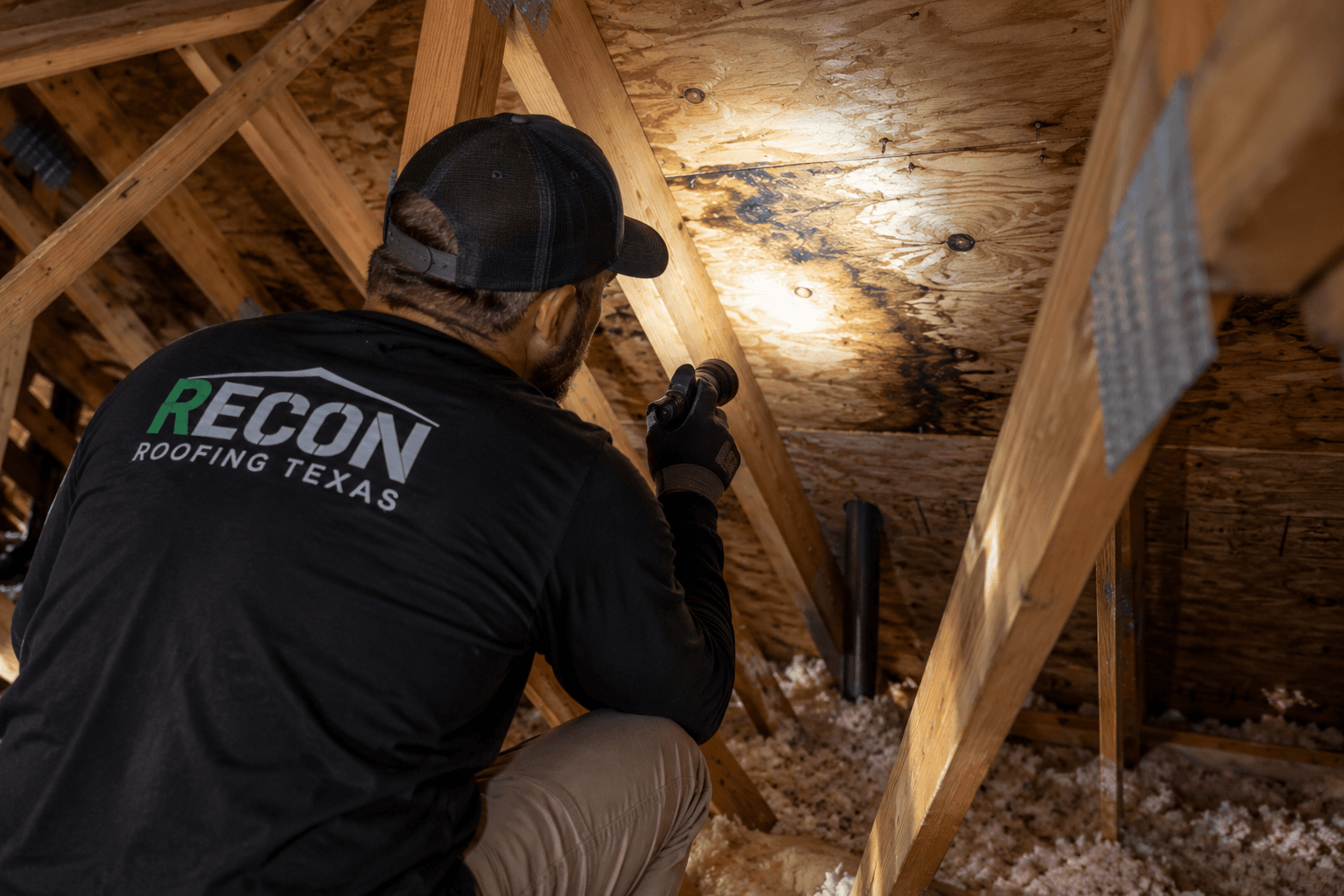
By the time there is a brown ring on your ceiling, the water has been getting in for a while. Weeks, usually. Sometimes a lot longer.
The good news is that most leaks are findable in an afternoon, without getting on the roof, if you look in the right order.
Water Does Not Fall Straight Down
This is the thing that makes leak hunting confusing, and everything else in this article depends on understanding it.
Water gets through the roof at one point. It hits the underside of the decking and it stops falling. Now it runs. It follows the slope of the deck, or it follows a rafter, or it wicks sideways along a seam, and it keeps going until it hits something that lets it drop. A nail tip. A gap. A low point.
Then it lands on the top of your ceiling drywall, where it spreads out and travels again before finding a seam or a light fixture to come through.
Two trips, both sideways. That is why the stain on your ceiling is almost never underneath the hole in your roof. On a low-slope roof the entry point can be a few feet away. On a steeper roof with long rafter runs it can be considerably more than that.
So the stain tells you a leak exists. It does not tell you where.
Go Up Before You Go Out
The attic is where you find leaks. The roof is where you confirm them.
Start inside. It is safer, it is faster, and the underside of your decking keeps a record that the top of your roof does not.
What to Take With You
A real flashlight, not your phone. You want something bright enough to throw light across the whole underside of the deck. Bring your phone anyway for photos. Something to kneel on. A marker or a piece of chalk.
Timing matters more than equipment. Go up once on a bright sunny day, when daylight through the deck is obvious. Then go up again during or right after a hard rain, when the water is actually moving. Those two trips tell you different things.
What You Are Looking For
Daylight first. InterNACHI, the home inspector association, puts the test simply: if you can see out, water may be able to find its way in. Turn your flashlight off, let your eyes adjust, and look at the deck and around every penetration.
Then look for staining on the underside of the sheathing. Dark discoloration usually means this has been happening long enough to grow something. InterNACHI notes that long-term leakage "often encourages mold growth, which usually appears as dark staining on the underside of roof sheathing." Decay shows up brown or white.
Look at the nails coming through the deck. Rust on nail tips means moisture has been present. This one matters later, so make a note of it.
Look at your insulation. Wet insulation is darker, flattened, and clumped compared to what is around it. A compressed patch in an otherwise fluffy attic is worth investigating even if you cannot see a stain above it.
One caution on stains. A dry stain is not proof of a fixed leak, and a wet stain is not proof of an active one. Inspectors use a moisture meter for exactly this reason. If it has not rained in three weeks, everything up there is going to read dry.
Mark Everything
Circle every stain, every rusty nail cluster, every damp spot with your chalk. Photograph each one with something in frame for reference, a rafter or a vent, so you can find it again.
You are not trying to solve it on this trip. You are building a map.
Then Work the Roof in Order of Likelihood
Here is the single most useful thing we can tell you about where leaks come from.
They almost never happen in the middle of a field of shingles. Shingles are good at their job. Leaks happen where something interrupts the roof, which means anything cut through it or joined to it.
Work the list in this order.
1. Pipe Boots
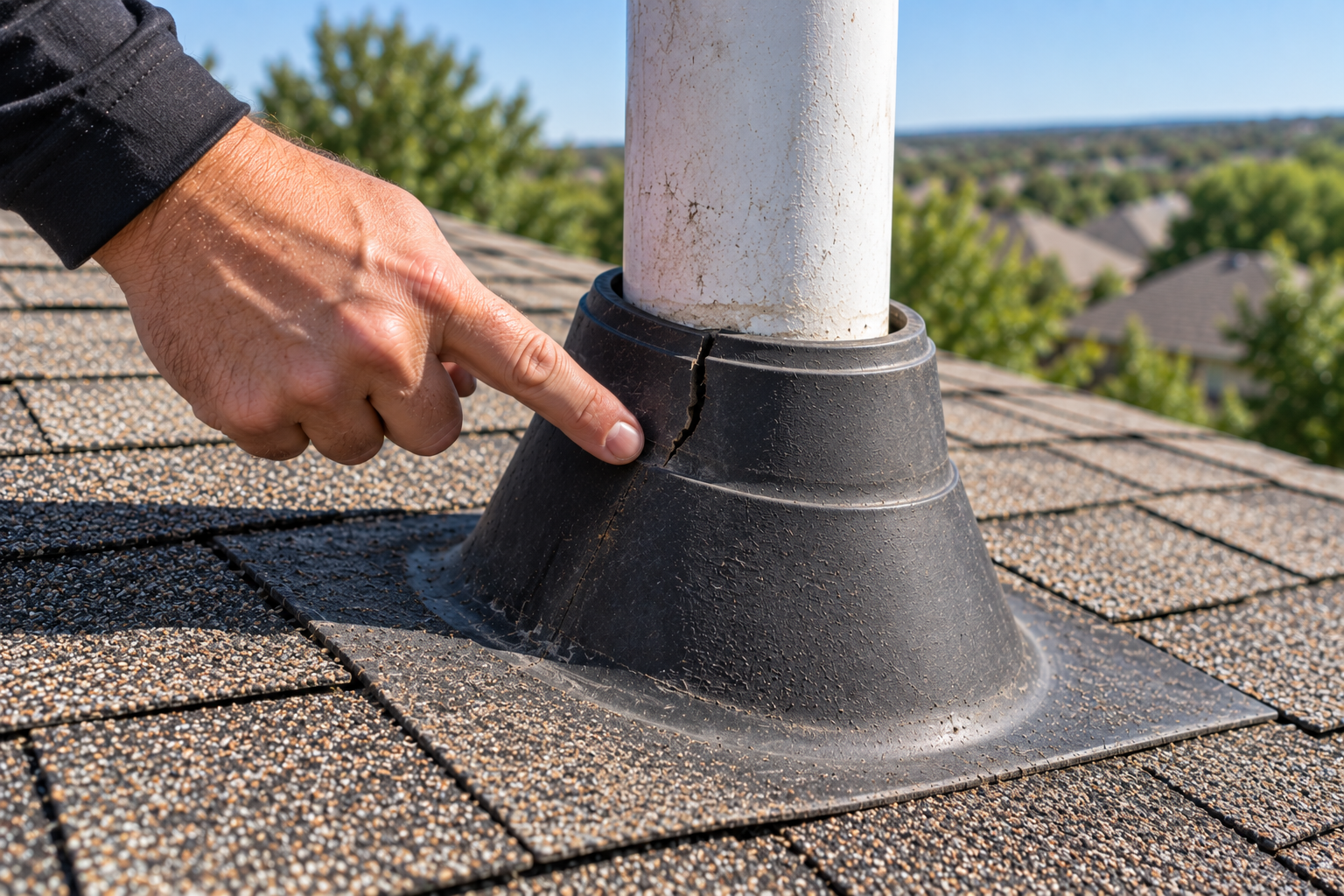
Start here. In Central Texas this is the most common leak we get called about, and it is not close.
A pipe boot is the collar that seals around your plumbing vent stacks. Most are neoprene rubber, and neoprene does not survive Texas UV. As InterNACHI puts it, as these boots get older "they dry out, crack and leak," and you may find them missing entirely. That usually happens somewhere in year eight to twelve, which is well before the shingles themselves are finished.
If you have a leak on a roof under fifteen years old with no storm history, check the boots first. Look for a split collar, a gap between rubber and pipe, or a boot that has pulled away from the shingle line.
2. Flashing
Anywhere the roof meets a wall or a chimney, there is metal doing the waterproofing rather than shingles. Chimney flashing, step flashing along a wall, counterflashing, headwall and sidewall transitions.
Flashing fails from sealant that has dried and shrunk, from fasteners backing out, or from having been reused on a previous roof job when it should have been replaced. On that last one the trade is not divided: IKO notes that the general consensus among roofers is that flashing should not be re-used, whatever the insurance paperwork says. Look for daylight, separation, or caulk that has cracked away from the metal.
3. Valleys
A valley is where two roof planes meet, and it carries more water than anything else on the roof. It is also where debris collects, which holds moisture against the roof and can dam water back under the shingle edges.
Clear the valley and look at the shingle cuts along it. On an older roof the granules in a valley wear first, because that is where all the water goes.
4. Fasteners and Anything Bolted On
Nail pops happen. A nail backs out slightly, lifts the shingle above it, and now there is a path.
Also look at anything somebody screwed into your roof after the fact. Satellite dish mounts, solar attachment points, old antenna brackets, holiday light clips left in place. Every one of those is a hole, and whoever made it may or may not have sealed it properly.
5. Vents and Skylights
Turbine vents, box vents, ridge vent ends, bathroom exhaust caps, skylights. Same principle. Anything cut into the roof has a seam, and seams fail before shingles do.
Skylights deserve extra attention. They leak at the flashing far more often than they leak at the glass, so the problem is usually around the unit rather than through it.
6. The Shingles Themselves
Last on the list, and genuinely uncommon as a single-point leak. When shingles are the actual problem it usually is not one bad shingle, it is a roof that has aged out across the whole plane. That is a different conversation, and it is covered in our guide to roof repair versus roof replacement.
The Water Test, Done Properly
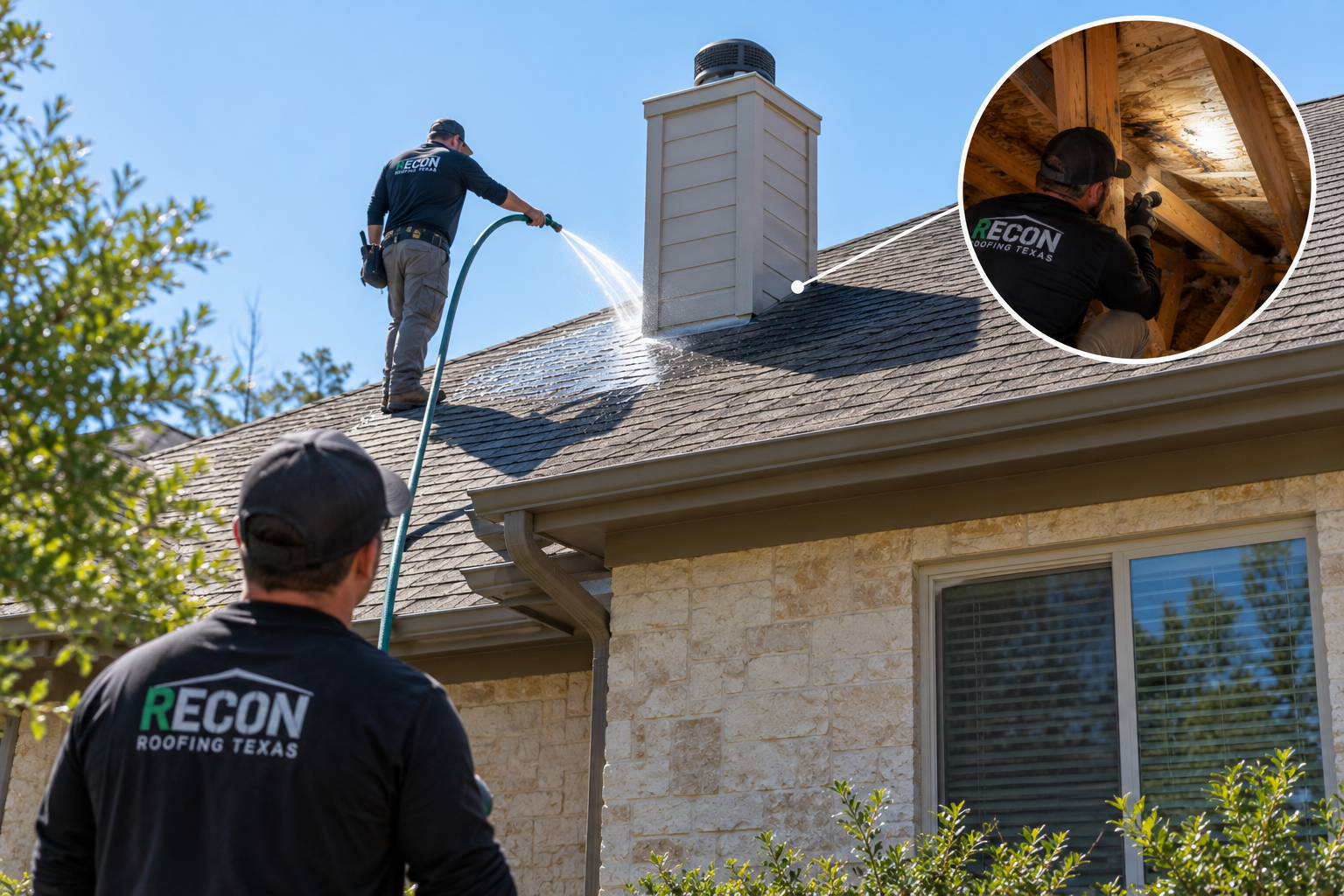
If the attic map and the roof inspection have not settled it, this is what actually works. Most people do it wrong and learn nothing.
You need two people and a garden hose. One person on the roof or on a ladder with the hose, one person in the attic with a flashlight and a phone.
The rules that make it work:
Start low and work up. Begin at the bottom edge of the roof below the suspect area. Water runs downhill, so if you start at the ridge you will soak everything below it and lose all your information.
One small area at a time. Isolate a single feature. One pipe boot. One section of valley. One side of the chimney.
Be patient. Run water on one spot for five to ten minutes before moving on. Real leaks often take several minutes to make it through the deck and show up inside. If you move every thirty seconds you will miss it and then have to start over.
Talk to each other. The person in the attic calls it the moment anything appears. Then stop the water and mark the spot.
Two hours of this will find most leaks that a visual inspection missed. It is tedious and it works.
One safety note. Do not do this on a wet roof, a steep roof, or a roof you are not comfortable on. You can run the hose from a ladder at the edge for the lower sections, and the parts you cannot safely reach are the parts to hand to somebody else.
Leaks That Are Not Roof Leaks
This is the section we would put first if it were not so counterintuitive, because in Central Texas a real share of what gets reported as a roof leak has nothing to do with the roof.
One question sorts it out in about ten seconds.
Does it correlate with rain? If your ceiling gets wet on a clear 101 degree afternoon in July, your roof is not the problem. Something else in your attic is producing water.
The usual suspects.
Your air conditioner. Most Central Texas homes have the air handler in the attic, with a condensate drain line carrying off the water it pulls out of the air. That line clogs with algae and sludge, the pan overflows, and water comes through the ceiling. InterNACHI puts the volume at up to 50 gallons on a very hot, very humid day, which is why this does so much damage so fast. They also give you the tell: if there is moisture dripping from a pipe stub under your eaves, that is the secondary drain doing its job because the primary line is blocked.
Bathroom exhaust ducts. This one is sneaky because it produces the exact symptoms of a roof leak. InterNACHI describes the mechanism: warm moist air escaping from unsealed duct connections "cools rapidly to its dew point, causing water vapor to condense on the coldest surfaces." The result, in their words, is "rusty roof nail tips and water staining on the underside of the roof deck sheathing."
Read that again, because it is the same evidence you were told to look for earlier. Rusty nails and deck staining can mean a leak, or they can mean a bathroom fan that vents into the attic instead of through the roof, or a duct with no insulation on it.
Plumbing. A supply line or drain in a wall or ceiling cavity produces a stain that looks identical from below. Again, the rain test sorts it.
Before you call a roofer, spend two minutes asking whether the water shows up when it rains or when it is hot. Getting that wrong costs you a service call and a wasted week.
While It Is Actively Leaking
If water is coming through right now, do these in this order.
Photograph it before you touch anything. If this turns out to be storm related, undocumented damage is a harder claim.
Move what you can and get a container under it.
If the ceiling is bulging, relieve it. That feels wrong, but a sagging drywall bubble full of water will eventually let go on its own schedule and take a larger piece of ceiling with it. A small hole with a bucket under it puts you in control of where it drains.
Stay off the roof. A wet roof is genuinely dangerous, and tarping in an active storm is how people get hurt. If it needs a tarp, that is a job for somebody with the right equipment on a dry day.
When to Stop Looking and Call Somebody
Call it when the roof is steep, wet, high, or you are not confident on a ladder. That is not caution, that is the correct decision.
Call it when the water test has come up empty twice. At that point you are likely dealing with either a non-roof source or something like a wind-driven leak that only appears under specific conditions, and both need different tools.
Call it when you find multiple entry points. Two or more separate leaks on the same roof is usually a sign about the roof's overall condition rather than a set of unrelated problems, and roof age becomes the more useful question. Our guide to how long a roof lasts in Texas covers what that means here.
And call it when you find it. Knowing where the water is coming in is most of the work. Fixing a pipe boot properly still means getting on the roof, pulling shingles, and reinstalling them so the repair sheds water instead of trapping it.
Write Down What You Found
Before you call anyone, spend five minutes turning your afternoon into a record. This is the step people skip and it is worth real money.
Write the date. Note the weather when the leak showed up, and whether it correlates with rain or with heat. List what you inspected and what you ruled out. Attach the attic photos with the chalk marks in them.
Three reasons this pays off.
It makes the roofer's visit faster, which on a diagnostic call often makes it cheaper. You are handing over an hour of work already done.
It gives you something to check the diagnosis against. If you found a split pipe boot directly above your marked stain and the roofer recommends a full replacement without mentioning the boot, you have a specific question to ask. What to do with an answer you do not like is covered in our guide to choosing a roofing contractor in Central Texas.
And if this ever becomes an insurance matter, a dated record of when the water started and what you did about it is exactly what a carrier wants to see. The Texas Department of Insurance is blunt about the line: most policies cover sudden and accidental water damage, and usually will not cover damage from gradual leaks. Being able to show you acted the week it started is worth having.
Not Finding It? We Will
Leak diagnosis is the part of roofing that rewards having done it several thousand times. A boot that reads fine from the ground splits open under a hose. A stain in the middle of a room traces back to a wall intersection eleven feet away.
We are a veteran owned crew out of Leander, and we run leak calls across Cedar Park, Round Rock, Georgetown, Liberty Hill and Pflugerville most weeks of the year. The inspection costs nothing and the findings come to you in writing with photos, whether the fix ends up being ours or not.
Bring us your chalk marks and your notes. If it turns out your air conditioner is the problem, we will tell you that and you will not owe us anything.
Schedule your free roof inspection and let us track it down.
Need help with your roof?
Text us for a free estimate. No pressure, no sales pitch.